4.9 Google Rating




How to Tell If a Tree Is Dangerous Before Minnesota’s Spring Storms Arrive
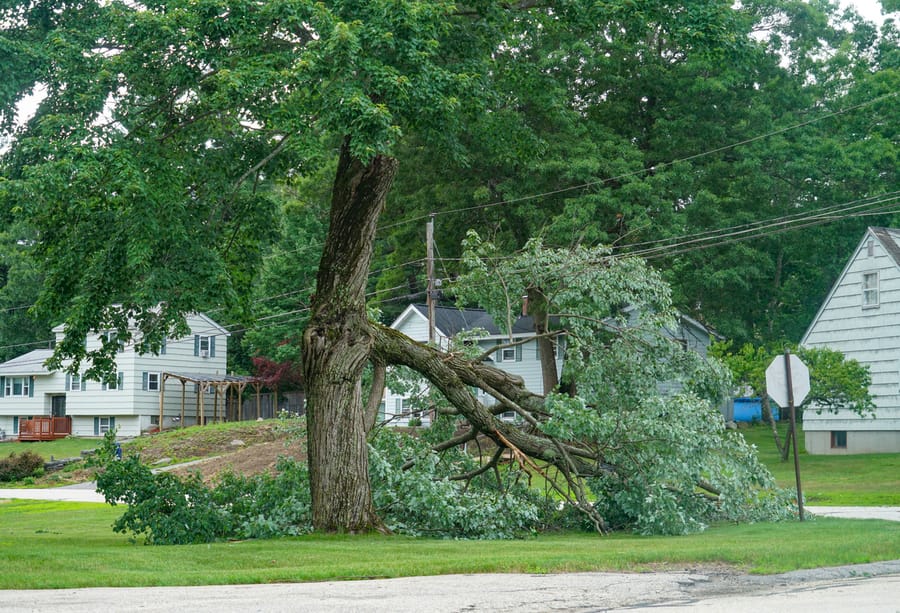
Spring in Minnesota is a season of dramatic change. As the ice finally retreats from our lakes and the first buds appear on our oaks and maples, there is a sense of renewal across the Twin Cities. However, this transition also marks the beginning of our most volatile weather period. Spring storms in Minnesota bring a combination of heavy, wet snow, high winds, and torrential rains that put immense pressure on our urban forest.
For homeowners, a tree that looked perfectly fine in the middle of January might actually be a significant hazard. Winter is hard on trees, and the structural integrity of your landscape can change significantly over a few months of sub-zero temperatures. Identifying these risks before the first major thunderstorm arrives is the best way to prevent property damage and ensure the safety of your family.
At Bratt Tree, we believe in a proactive approach to tree care. A tree does not usually fall without warning. Most failures are the result of long-term decay or structural weaknesses that become visible once you know what to look for. In this guide, we will help you perform a ground-level audit of your trees so you can decide when it is time to call in a professional arborist.
The Impact of Minnesota Winters on Tree Stability
Our local climate is uniquely challenging for trees. The extreme temperature fluctuations we experience in late winter and early spring can create mechanical stress within the wood itself.
The Freeze-Thaw Cycle
Water expands when it freezes. If a tree has an existing crack or a hollow pocket, moisture gets inside and freezes, acting like a wedge. Over a single winter, a small, manageable crack can grow into a deep structural split. When spring rains arrive and add thousands of pounds of water weight to the canopy, these weakened areas are often the first to fail.
Frost Heave and Roots
The ground itself moves during a Minnesota spring. As the frost line rises and falls, the soil shifts. This can heave roots out of the ground or sever the fine feeder roots that help anchor the tree. If the soil becomes oversaturated from melting snow, the root plate can lose its grip on the earth, making even a healthy-looking tree susceptible to toppling in high winds.
Visual Red Flags: What to Look for from the Ground
You do not need to be a certified arborist to spot some of the most common signs of a dangerous tree. Take a walk around your property on a calm day and look for these specific indicators.
Deadwood and Hanging Branches
Often called “Widow-Makers,” dead branches are the most frequent cause of storm damage.
-
The “Snap” Risk: Dead wood is brittle. It cannot bend with the wind like a living branch.
-
Bark Loss: If a large limb has lost its bark or looks grey and weathered compared to the rest of the tree, it is likely dead and ready to fall.
-
Hangars: Look for branches that have already broken but are caught in the canopy. The next high wind will likely bring them down onto your roof or power lines.
V-Shaped Crotches and Included Bark
The way a tree’s branches attach to the trunk tells a story about its strength.
-
U-Shape is Strong: A wide, U-shaped union is generally stable.
-
V-Shape is Weak: A tight, V-shaped union often contains “included bark.” This means the bark is growing inward, preventing the two stems from actually bonding together. During a storm, these stems act like a lever, prying each other apart until the tree splits down the middle.
Trunk Decay and Cavities
Internal rot is one of the most dangerous hazards because it is often hidden.
-
Mushrooms and Conks: If you see fungi growing on the trunk or near the base, it is a sign that the tree is rotting from the inside out. The fungus is the fruit of a much larger decay system within the wood.
-
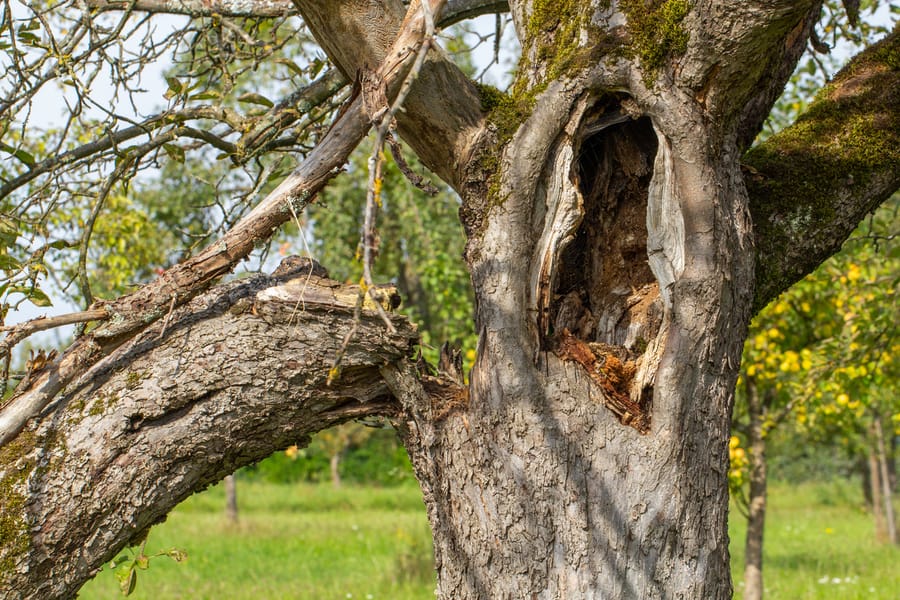
Hollows: A hole in the tree is not always an immediate death sentence, but if the shell of healthy wood around the hole is too thin, the tree lacks the strength to stand up to a Minnesota gust.
Deep Vertical Cracks
Not all cracks are equal. Frost cracks are often superficial and occur on the south or west side of the trunk due to sun scald. However, deep cracks that go through the bark and into the wood, especially if they are on opposite sides of the trunk, indicate that the tree is beginning to fail structurally.
Root System Red Flags
A tree is only as stable as its foundation. Because the root system is mostly underground, you have to look for subtle clues on the surface.
The Tipped Trunk
If a tree has always had a lean, it has likely grown compression wood to compensate. However, if a tree suddenly starts leaning after a winter storm or during the spring thaw, it is an emergency. A new lean means the roots are failing.
Cracked or Heaving Soil
Look at the ground on the side of the tree opposite the lean. If you see mounds of soil lifting up or fresh cracks in the earth, the root plate is moving. This tree is at high risk of a complete failure, where the entire tree uproots.
Girdling Roots
In urban Twin Cities landscapes, trees are often planted in holes that are too small or have poor soil. This leads to girdling roots that wrap around the trunk like a noose. Over time, these roots choke off the flow of nutrients and create a weak point where the trunk can snap off at the ground level.
Species-Specific Risks in the Twin Cities
Certain trees are more prone to storm damage than others. In Minnesota, we pay close attention to several common species.
-
Silver Maples and Willows: These are fast-growing trees with soft wood. They are notorious for dropping large limbs during the heavy, wet snowfalls of late March and April.
-
Ash Trees: If you have an Ash tree that has been affected by Emerald Ash Borer, it is structurally compromised. EAB-infested wood becomes extremely brittle. Even if the tree still has some green leaves, it can shatter during a windstorm.
-
Conifers (Pines and Spruces): Because these trees keep their needles year-round, they act like a sail. They catch the wind much more than a leafless deciduous tree, making them prone to toppling in early spring storms.
Why Professional Inspection Outperforms DIY
While a homeowner can spot a dead branch, many structural issues are invisible to the naked eye. At Bratt Tree, our certified arborists use advanced technology to evaluate tree health.
-
Sonic Tomography: This allows us to see inside the trunk using sound waves, creating a map of where the wood is solid and where it is hollow.
-
Resistive Drilling: We use a tiny needle to measure the density of the wood, identifying soft spots that indicate active decay.
-
Aerial Inspections: Sometimes a hazard is only visible from the top down. Our climbers can identify cracks in the upper canopy that you would never see from the sidewalk.
Protecting Your Landscape Investment
Your trees are some of the most valuable assets on your property. They provide shade, beauty, and privacy, but they also carry a responsibility. Taking the time to evaluate your trees before the spring storm season begins can save you from the “emergency” costs and heartbreak of a fallen tree.
In many cases, a dangerous tree can be saved through strategic pruning, cabling, or bracing. The goal is not always removal; it is risk management.
Contact Bratt Tree today to schedule a pre-storm safety audit with one of our certified arborists and ensure your Twin Cities home is ready for whatever the Minnesota spring brings.